
To appear in Google AI Overviews, structure your content so that every section opens with a standalone answer to a specific user question, establish an unambiguous brand entity in Organization schema, and map your content entities to verified reference sources such as Wikipedia. Domain authority is not the absolute prerequisite many guides imply — citation eligibility is increasingly evaluated at the page level, and content structure can earn citations even where domain-level authority is limited.
This is a first-person account of exactly what I implemented, what I observed, and what the results mean for e-commerce brands trying to understand how AI search visibility actually works in practice. The brand is Bee Pontoon (beepontoons.com), a startup selling bee watering station products on Shopify. By June 2026 — four months after launch — the site earned three separate in-text citations inside a single Google AI Overview, a named product recommendation in ChatGPT, and image and link citations in Perplexity. By August 2026 the pattern had extended across the content cluster: four of the five cluster pages plus the pillar page were appearing in AI-driven Google surfaces, including a page targeting the opposite search intent. This post documents the methodology I implemented, the results that followed, and — in a dedicated section — what this case can and cannot prove.
Key Takeaways
- Google AI Overview citations are achievable on new domains — domain authority alone is not the gating factor.
- Answer-first content architecture — where every H2 section opens with a standalone 40-60 word answer paragraph — is designed to produce multiple citation-eligible passages within a single URL. This case produced three citations from one post, which is consistent with that design.
- Entity disambiguation is the element of this case with the clearest mechanism: resolving what the brand is not, in schema, preceded ChatGPT naming the product accurately rather than conflating it with unrelated businesses.
- A four-type schema stack (HowTo, Article, Organization, WebPage) with Wikipedia entity mapping was deployed as the machine-readable layer. Google and Microsoft have confirmed structured data helps their AI systems understand and verify content — but Google has also stated no special schema is required for AI Overviews, and this case cannot isolate schema’s independent contribution.
- The same content asset produced citations across three platforms simultaneously — Google AI Overviews, ChatGPT, and Perplexity — from a single optimized page.
- Four months later the pattern had replicated across the cluster: four of five cluster pages plus the pillar page appearing in AI-driven Google surfaces, including the page written for the opposite search intent. Replication across pages is stronger evidence than a single citation event.
- Citations aren’t permanent: the pillar page was cited for the head category term “bee watering station” one morning, then the citation was gone by later that day — a real example of the volatility published research describes.
- This remains an uncontrolled case with several variables changed at once. It documents that the approach is viable and that the result repeats across a cluster — not which element causes what.
- Why Does Domain Authority Keep Getting Blamed for AI Overview Exclusion?
- What Was the Bee Pontoons Challenge?
- What Was the Hypothesis Behind This Approach?
- What Content Methodology Did I Implement?
- What Schema Did I Deploy and Why Does the Stack Matter?
- What Were the Verified Results Across Platforms?
- What Happened Across the Rest of the Cluster?
- What Are the Limits of This Case Study?
- What Does This Mean for E-Commerce Brands Trying to Rank in AI Search?
- What Is the Replicable Framework for Other E-Commerce Brands?
- 1. Identify a High-Intent Pre-Purchase Query in Your Category
- 2. Build a Single, Deep Answer Asset for That Query
- 3. Build Your Organizational Entity Architecture First
- 4. Deploy the Four-Type Schema Stack on Content Pages
- 5. Map Entities Throughout the Content
- 6. Implement at Launch, Not After a Link-Building Phase
- Frequently Asked Questions
- How do you appear in Google AI Overviews?
- How do you rank in AI search across multiple platforms?
- What is Google AI Overview optimization?
- What does a generative engine optimization case study look like in practice?
- Does a topic cluster help with AI Overview citations?
- Can a new website earn Google AI Overview citations?
Why Does Domain Authority Keep Getting Blamed for AI Overview Exclusion?
A common assumption in Google AI Overview optimization guides is that citations correlate strongly with established, high-authority domains — and that assumption has weakened. Ahrefs’ July 2025 study of roughly 1.9 million citations found 76.1% of AI Overview citations came from pages ranking in Google’s top 10. A larger follow-up published in March 2026, covering 863,000 keywords and about 4 million AI Overview URLs, put that figure at 37.9%, with the remainder split almost evenly between pages ranking 11–100 (31.2%) and pages beyond position 100 (31.0%). Citation eligibility increasingly appears to be evaluated at the page and topic-cluster level rather than the domain level.
Two precisions on those numbers, because they are widely quoted as a clean 76% → 38% collapse and Ahrefs itself is more careful than that. First, Ahrefs notes its citation detection improved between the two studies, which means the datasets are not directly comparable and some of the gap is measurement rather than behaviour. Second, Google made Gemini 3 the global default model for AI Overviews on 27 January 2026, shortly before the second study — a plausible contributing factor. The 37.9% figure also counts all SERP blocks including ads, featured snippets and People Also Ask; filtering to standard organic listings only gives 37.1%. The direction of travel is well supported. The precise magnitude is not.
The Bee Pontoons case is consistent with that shift — three AI Overview citations on a domain with minimal authority at launch, with no link building involved.
The mechanism behind this shift is what Ahrefs and Google describe as query fan-out: when a user’s search triggers an AI Overview, Google expands the original query into multiple related sub-queries and evaluates pages across that entire cluster, not just the page-one results for the original term. This granular evaluation lets the AI model bypass traditional page-one results and surface hyper-specific passages from deeper, niche domains — pages with strong topical relevance to a sub-query, even without the backlink profile to rank top-10 for a broader head term. In this case, the head term would be something like “bird bath” or “bee watering station,” where established gardening and wildlife publications dominate. A four-month-old domain with a single, deeply optimized, answer-first blog post is the kind of asset this mechanism is built to surface: narrow in scope but precisely matched to the sub-query a fan-out expansion would generate.
I built and launched beepontoons.com in February 2026 with zero domain authority. By June 2026 — four months later — that site earned three separate in-text citations inside a single Google AI Overview response, a named product recommendation in ChatGPT, and image and link citations in Perplexity. This post documents exactly what I implemented and why. For context on how this approach differs from conventional search optimization, see the full breakdown of how GEO differs from traditional SEO.
What Was the Bee Pontoons Challenge?
Bee Pontoons launched as a brand-new domain in February 2026 with zero domain authority, no backlinks, no existing content index, and no search history. The brand sells bee watering station products in a niche outdoor and garden e-commerce category. The goal from day one was to make the site AI-search-ready at launch — applying content structure and schema methodology to earn citation eligibility immediately rather than waiting for organic authority to accumulate first.
The target query was not a branded search. It was a category-level, high-intent informational query: “how to stop bees drowning in bird bath.” This is the type of query a potential buyer types before they know a product like Bee Pontoons exists — identifying a problem before naming a solution. Earning a citation in the AI Overview for this query means appearing at the exact moment a prospective customer is defining their problem, before any competitor has had the chance to name a recommendation.
The head terms in this category — “bird bath,” “bee watering station” — surface content from established gardening publications, wildlife organizations, and home improvement sites with substantially higher domain authority than a four-month-old Shopify store. The specific long-tail query I targeted is a narrower field, and that narrowness is part of the strategy rather than an accident: it is the kind of specific, procedural sub-query that a fan-out expansion generates and that few established publishers have written a dedicated asset for. I return to what that means for interpreting the result in the limitations section below.
What Was the Hypothesis Behind This Approach?
My hypothesis was that Google AI Overviews select content based on structural answer-readiness — not solely on the authority of the domain it comes from. If a brand-new domain publishes content structured to function as a direct, entity-complete, schema-supported answer to a specific user question, it should be eligible for AI Overview citation regardless of its domain authority. Bee Pontoons was a live commercial test of that hypothesis — not a controlled experiment, since several methodology elements were deployed together at launch.
This hypothesis runs counter to a common assumption in google ai overview optimization guides — that strong organic rankings and established domain authority are prerequisites for citation eligibility, with content structure treated as a secondary refinement rather than the primary lever. My working model inverts that priority: optimize content structure and schema for citation eligibility first, and treat that as a foundation on which authority compounds over time. The four-month result from Bee Pontoons is consistent with that model — with two important precisions, one in the methodology section below and one in the limitations section.
What Content Methodology Did I Implement?
The content methodology I used for the cited Bee Pontoons blog post is answer-first content architecture: every major section opens with a standalone 40-60 word paragraph that directly answers the implicit question that section addresses. These answer paragraphs are written to function as citable responses — complete, accurate, and self-contained without requiring surrounding context. This structure reflects how search experience optimization principles intersect with AI retrieval behavior.
Answer-First Section Structure
The answer-first approach is not the same as putting a summary at the top of a page. It means structuring every H2 section so that the first paragraph after the heading is the answer — not a preamble, not a transition, not a contextual setup. Supporting detail follows that opening answer paragraph. The intent is to make it straightforward for an AI system to identify the most answer-dense sentence cluster in each section and extract it as a citation without distorting the content’s meaning.
This is the element of the methodology with the strongest independent support in published research. Growth Memo’s analysis found pages with headlines that directly answer the question get cited by ChatGPT 41% of the time, against 29% for loosely related headlines, and that 44.2% of LLM citations come from the first 30% of a text. Answer-first structure targets both findings directly.
For the Bee Pontoons post targeting “how to stop bees drowning in bird bath,” this meant every section — from why bees drown in bird baths, to what physical features prevent drowning, to specific product solutions — opened with a paragraph that could stand alone as a complete, accurate answer to that section’s implied question. The URL of the cited post is: beepontoons.com/blogs/education/stop-bees-drowning-bird-bath
Entity-Based Content Optimization and Wikipedia Mapping
Entity-based optimization means identifying the named concepts, species, behaviors, and products that are semantically central to your topic and ensuring they appear in your content in a way that mirrors how those entities are described in authoritative reference sources. For the Bee Pontoons post, this included entities such as bee behavior, bee hydration biology, bird bath safety hazards for pollinators, and bee watering station design features.
I mapped these entities to their corresponding Wikipedia pages and referenced those pages in the schema markup. This is not a link-building tactic — it is an entity disambiguation signal. The intent is to tell knowledge graph systems that the content on this page concerns the same concepts Wikipedia’s knowledge base covers under specific entity nodes, reducing the ambiguity an AI system has to resolve before it can cite the page confidently.
Entity Architecture: Connecting a New Domain to an Established Brand
One element of the methodology worth documenting precisely: while beepontoons.com was a brand-new domain, the Bee Pontoon brand entity was not starting from zero. The product had been available on Amazon since August 2024 under the Trimyxs LLC parent organization — an established North Dakota company with its own domain and brand history. In the Organization schema deployed on beepontoons.com, I mapped Bee Pontoon explicitly as a subOrganization of Trimyxs LLC, with parentOrganization linking back to the established parent entity at trimyxs.com/#organization.
This cross-domain entity connection gave AI systems a verified organizational context for the new domain — not an isolated site, but a named brand subsidiary of an established company with a traceable legal and commercial history. This is an important precision on the “zero authority” framing: the domain was new, but the brand entity was anchored to an established parent organization through schema.
I also included a disambiguatingDescription in the schema that explicitly clarified what Bee Pontoon is not — a pontoon boat rental service — addressing a genuine entity confusion problem. Before this was in place, AI systems conflated the brand with unrelated businesses using similar terminology. After it was in place, ChatGPT named the product with a specific benefit description. This is the clearest before-and-after in the case: a specific ambiguity, a specific fix, and an observable change in how the brand was described.
A Note From Practice
The disambiguatingDescription field is one of the most underused properties in Organization schema. For any brand with a name that could be confused with another entity — a different industry, a geographic namesake, a similar product category — explicitly stating what the brand is not is as important as stating what it is. AI systems need to be confident in their citation, and confidence requires disambiguation. If your brand name carries any ambiguity, resolve it in schema before expecting AI engines to describe you accurately.
What Schema Did I Deploy and Why Does the Stack Matter?
On the cited Bee Pontoons blog post, I deployed four schema types together: HowTo, Article, Organization, and WebPage, with entity properties mapped to Wikipedia references throughout. Each addresses a different layer of machine-readability. Before describing them, one thing worth stating plainly: Google has said that no special schema is required for AI Overviews or AI Mode. Schema reduces ambiguity about what a page and a brand are. It is not a switch that produces citations.
What the platforms have confirmed is narrower than most schema advice implies. Google’s Search team has stated that structured data gives an advantage in search results, and Microsoft Bing’s principal product manager has confirmed schema helps their LLMs understand content for Copilot. That is a claim about comprehension and verification, not about citation. It is also worth reporting the contrary evidence, of which there is now more than one study. SE Ranking’s analysis of 2.3 million pages found FAQPage schema markup had no measurable impact on AI Mode citations, while FAQ sections in the visible content correlated with more citations (4.9 versus 4.4). Ahrefs’ own large-scale AI search research reached a similar conclusion, reporting effectively no meaningful correlation between schema markup and AI citation, with off-site brand signals — YouTube and branded web mentions in particular — showing far stronger correlations than any markup type. The pattern that emerges across both is that content and brand presence earn citations, and schema clarifies what the content is about.
HowTo Schema
The query “how to stop bees drowning in bird bath” is a procedural how-to query, and HowTo schema declares the content as a structured sequence of steps addressing that intent. Each step maps to a section of the post’s answer-first structure.
One caveat to state directly: Google retired HowTo rich results in 2023, so this markup earns no display treatment in Search. It remains a valid schema.org type and contributes machine-readable structure, and I deployed it for that reason — not for a rich result, and not on any confirmed basis that it influences AI Overview citation.
Article Schema
Article schema establishes the content type and supports authorship attribution. For AI systems evaluating content credibility, Article schema with explicit author, publisher, and dateModified properties provides structured signals about who produced the content, in what editorial context, and how recently it was updated — supporting E-E-A-T assessment at the schema level.
Organization and WebPage Schema
Organization schema establishes the brand entity — Bee Pontoon as a named, defined organization with properties including URL, name, description, parent organization, and Wikipedia entity references. WebPage schema connects the individual post to its parent domain and provides page-level metadata. Together, these tell AI systems that the post exists within a coherent, named entity context rather than as an isolated page on a new domain.
Of the four types, Organization is the one I would prioritize if forced to choose, and it is the one with the most external support. Practitioner consensus in 2026 holds that brand identity is the foundation AI systems use to evaluate source reliability — without it, systems have to guess who you are, and that ambiguity reduces citation confidence. On a new domain this matters more than usual, because there is no accumulated backlink or indexing history to supply that context implicitly.
What Were the Verified Results Across Platforms?
By June 2026 — four months after launch — the Bee Pontoons site earned verified AI search citations across three platforms: three in-text citations within a single Google AI Overview response, a named product recommendation in ChatGPT, and both image and link citations in Perplexity. All results were documented with screenshots at the time of verification. The cited blog post had been live for approximately two months at the time — published April 2, 2026 on a domain launched in February 2026.
Google AI Overview: Three In-Text Citations
The most significant result was three separate in-text citations within a single Google AI Overview response for the query “how to stop bees drowning in bird bath.” The cited URL was beepontoons.com/blogs/education/stop-bees-drowning-bird-bath. Three citations within a single AI Overview response means Google’s retrieval system identified multiple distinct answer passages within the same post as citation-worthy for different parts of the generated response — consistent with the answer-first section structure, where each section was written to produce a citable passage independently.
The citations appeared on a domain with no established traffic performance, following implementation of the content structure and schema described above, on a blog post published just two months earlier. Which elements of that implementation drove the result cannot be isolated from a single uncontrolled case — see the limitations section below.

ChatGPT: Named Product Recommendation
For category-level queries about bee watering solutions, ChatGPT surfaced Bee Pontoons as a named product recommendation, describing it as “one of the more thoughtfully designed products” with a specific benefit description. Before the disambiguatingDescription was in place, the brand was being conflated with pontoon boat businesses; afterwards, ChatGPT named the product accurately and attached a specific benefit. Of everything documented here, this is the observation where the link between a specific implementation detail and a specific change in output is clearest — though it remains a single before-and-after observation, not a controlled test.

Perplexity: Image and Link Citations
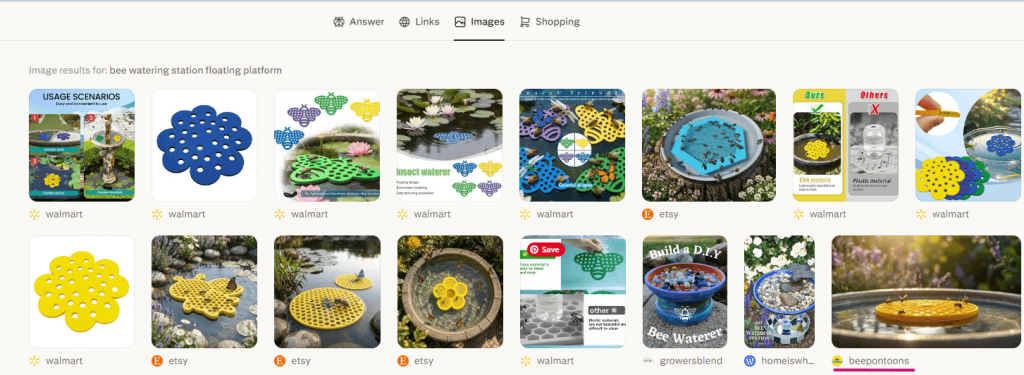
Perplexity surfaced both image citations and link citations from the Bee Pontoons site for target queries. Image citation by Perplexity requires that images be properly attributed and accessible — a product of clean technical implementation on the Shopify site alongside the content methodology. Link citations in Perplexity came from the same answer-first, entity-mapped content that produced the Google AI Overview citations.
Across all three platforms, the same content asset — one blog post, one schema stack, one entity-mapped content methodology — produced citations in Google AI Overviews, a named recommendation in ChatGPT, and image plus link citations in Perplexity. For e-commerce brands thinking about multi-platform AI search visibility, this cross-platform citation pattern from a single optimized asset is the most operationally relevant finding from this case.

What Happened Across the Rest of the Cluster?
The original citation was a single page. By August 2026, four of the five cluster pages plus the pillar page were appearing in AI-driven Google surfaces — inline AI Overview citations, AI Overview source panels, and an owned People Also Ask answer. That changes what this case can claim: not that one page got lucky, but that the pattern repeated across a cluster, including on a page targeting the opposite search intent.
The Bee Pontoons content is not a single blog post. It is a topic cluster: one pillar page covering bee watering stations end to end, with five cluster pages each answering one specific question the pillar deliberately does not resolve in full. The original case study documented one of those cluster pages. What follows is what happened to the rest.
A note on how these results are labelled, because the surfaces are not equivalent. An inline citation means Google attributed a specific sentence in the AI Overview answer directly to the page — the strongest form of visibility. A source panel appearance means the page was listed among the AI Overview’s sources without a specific passage being attributed to it. An owned PAA answer means Google expanded a People Also Ask question using content pulled from the page. These are different levels of prominence, and conflating them would overstate the result.
| Cluster page | Query | AI surface | Verification |
|---|---|---|---|
| Stop bees drowning in bird bath | how to stop bees drowning in bird bath | 3 inline AI Overview citations | Screenshot, June 2026 |
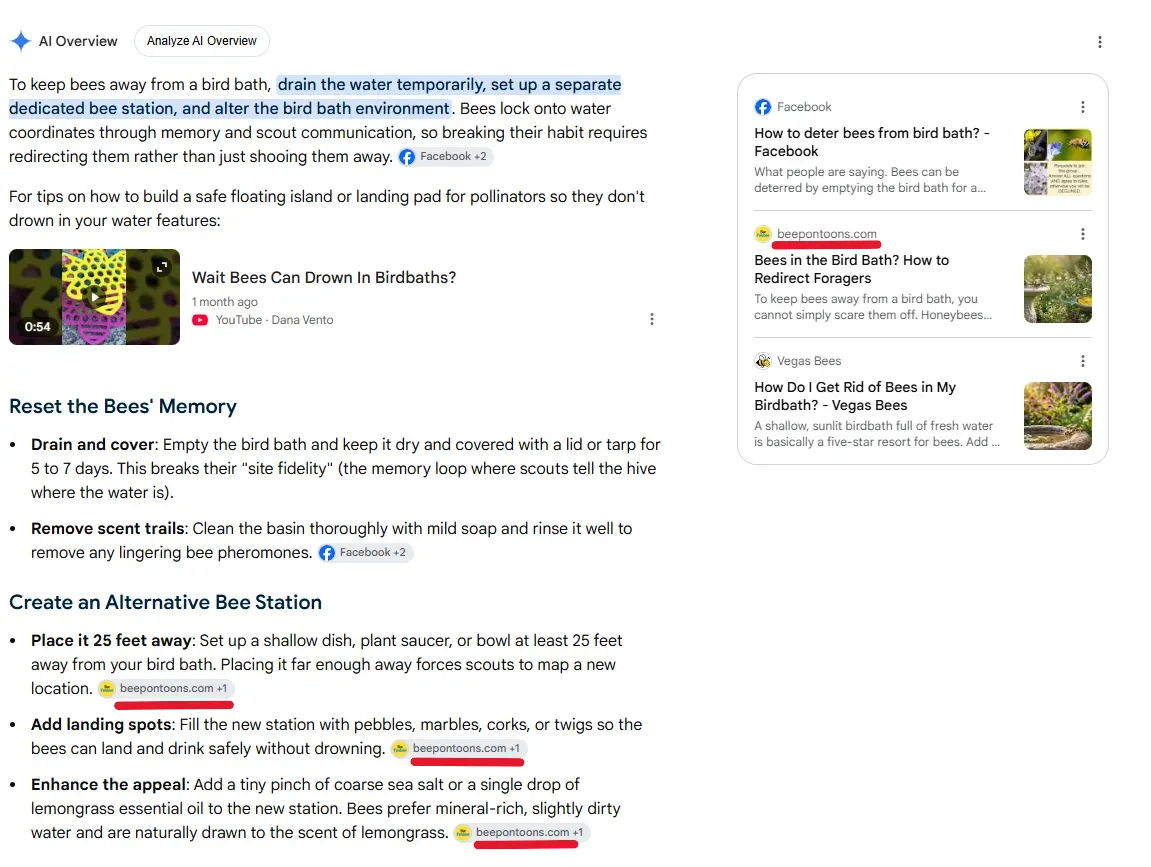
| Keep bees away from bird bath | how to keep bees away from bird bath | 3 inline AI Overview citations + source panel; organic position 8 as last checked | Screenshot + live SERP pull, August 2026 |
| Bee watering station guide (pillar) | are bee watering stations safe | Owned People Also Ask answer; organic position 3 | Live SERP pull, August 2026 |
| Are DIY bee watering stations safe? | are DIY bee watering stations safe | AI Overview source panel | Screenshot, August 2026 |
| Where to place a bee watering station | how to attract bees to water station | AI Overview source panel | Screenshot, August 2026 |
| Sugar water for bees recipe | sugar water for bees recipe | No AI surface observed; organic page 2 | Screenshot, August 2026 |
The opposite-intent page is the most compelling result in this table. “How to keep bees away from a bird bath” stands in contrast to the brand’s usual content — it guides users on deterring bees rather than attracting them. However, its inclusion in the cluster was intentional. A topic cluster that only targets favorable intent is just a sales funnel in disguise. By addressing real-world queries in the same semantic space, the brand builds authority. In fact, the post seamlessly integrates a solution — positioning a dedicated bee watering station away from the bird bath as a scientifically grounded alternative. This approach delivers the exact type of genuinely helpful content that Google rewards.
That page now holds three inline AI Overview citations and organic position 8 as last checked. I verified it with a live SERP pull rather than relying on the screenshot alone, because AI Overviews change roughly every two days and a single observation proves very little. Both the screenshot and the independent pull returned the same citations.
The pillar page owns a People Also Ask answer. For “are bee watering stations safe,” Google expands the PAA question using content drawn directly from the pillar page. This is worth separating from the AI Overview results: People Also Ask is a persistent SERP feature rather than a regenerated answer, so it does not carry the same volatility. The same query returns the pillar at organic position 3.

One page has not produced an AI surface. The sugar water recipe page ranks on page two organically and has not appeared in an AI Overview for its target query. I include it because a results table that only lists wins is not a results table. It is also the page whose query has the most established competition — the SERP includes sites with domain authority in the 24 to 96 range, against a domain that was five months old at the time of writing.
A Note From Practice
The brand also appears in Google’s product carousel for “bee watering station.” I have deliberately left that out of the table above, because it is a Shopping surface driven by product feed data — an entirely different mechanism from AI Overview citation. Mixing commercial product listings into AI citation evidence is one of the easier ways for a case study to overstate its results, and it is worth being strict about the distinction even when the extra data point would look good.
A Documented Example: A Same-Day Citation, Then Gone
On the morning of August 5, 2026, the pillar page earned an inline AI Overview citation for “bee watering station” — the head category term, not a long-tail question. By later the same day, the citation was gone. A live SERP pull showed the AI Overview fully regenerated with an entirely different reference set. This is not a hypothetical drawn from someone else’s research — it is a documented instance of the same underlying phenomenon Ahrefs describes, observed on this exact page. Ahrefs’ own study notes their checks weren’t daily, meaning the true churn rate is likely faster than their 2.15-day average suggests; a same-day change is consistent with that.
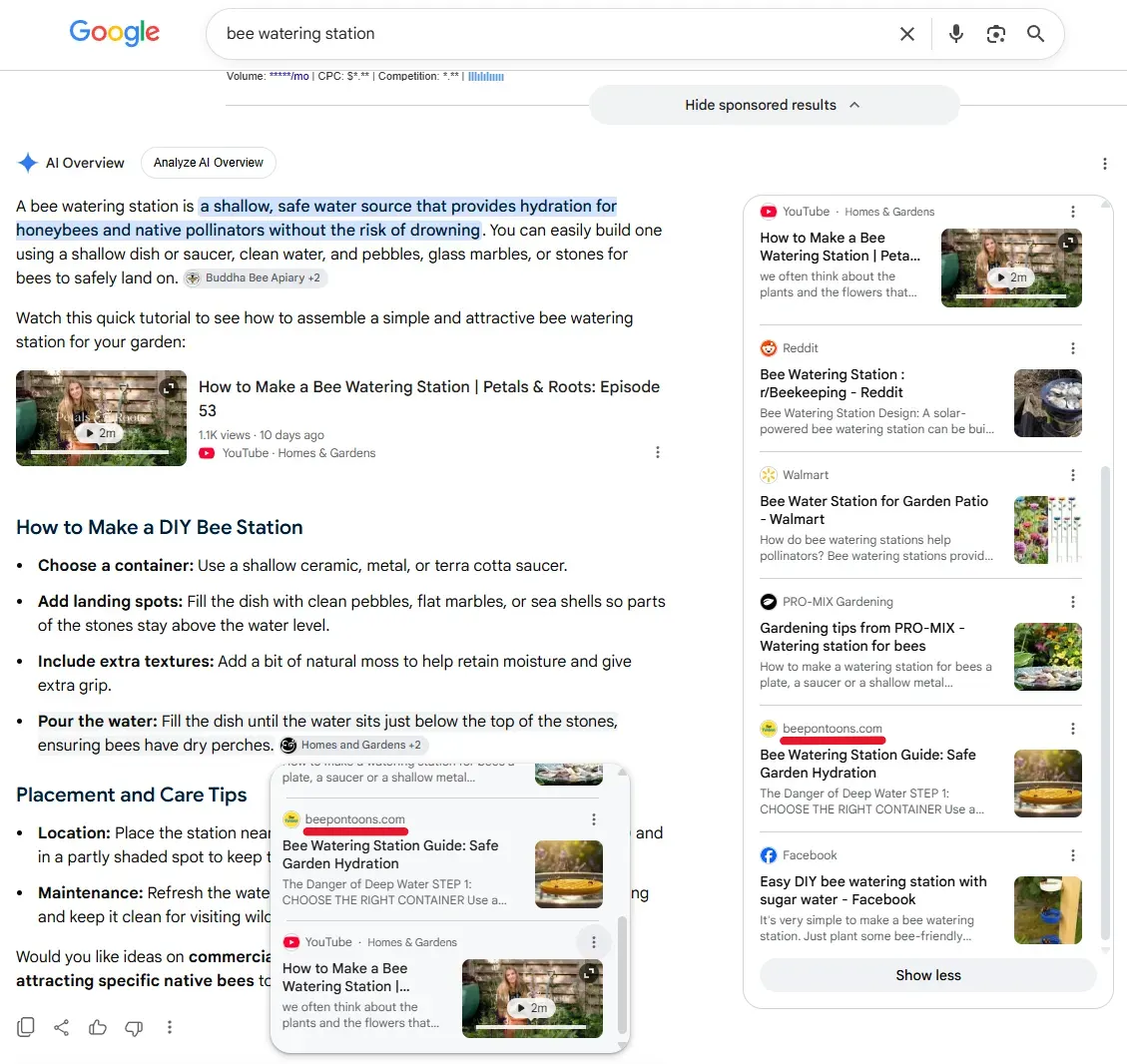
The morning citation was verified by screenshot. The later absence was verified independently, via a live SERP pull rather than a second screenshot — and cross-checked again against a related People Also Ask expansion, which returned a completely different reference set with no mention of the domain. Two independent checks, same result: the citation was gone, not delayed or cached differently.
One thing did not change: the page’s presence in Google’s Popular Products carousel for the same query held in both checks. That distinction is worth sitting with. AI Overview citation and Popular Products placement are different mechanisms, evaluated separately, and they did not move together here — one was volatile, the other was stable across the same window.
This is presented as a single dated observation, not a trend. It says nothing about how often this page cycles in and out of citation, or whether a same-day change is typical or unusual for this query specifically. What it does establish is that the volatility described later in this case study is not an abstraction — it happened, on this page, while this case study was being written.
What Are the Limits of This Case Study?
This is one cluster on one domain, with several variables changed simultaneously, which means it can demonstrate that the approach is viable but cannot establish which element produced the result. Answer-first structure, Wikipedia entity mapping, four schema types, a disambiguating description, a parent-organization anchor, and the choice of narrow procedural queries were all deployed together. Any one of them, or their combination, could account for the citations.
What the cluster-level results do and do not add. The original version of this case study rested on a single citation event on a single page. Five pages now show AI-surface visibility, across a four-month window and including opposing search intents. That is a meaningful improvement: a one-off result can be coincidence, while a pattern that repeats across a cluster is harder to explain that way. What it is not is a controlled test. Every page in the cluster shares the same methodology, the same domain, the same entity architecture and the same parent-organization anchor, so the pages are not independent observations. Five correlated results from one implementation are still one implementation.
The query was narrow, and that cuts both ways. “How to stop bees drowning in bird bath” is a specific procedural question with a small field of dedicated content. The strategic case for targeting it is real — it is exactly the sub-query a fan-out expansion generates. But a simpler explanation is also available: there may have been few strong sources competing for it. I cannot rule that out, and anyone replicating this should expect a harder result in a more contested category.
The “zero authority” framing has a genuine caveat, stated earlier and worth repeating here: the domain was new, but the brand entity was anchored to Trimyxs LLC, an established company with commercial history and a product on Amazon since August 2024. A brand with no such parent entity is starting from a different position than this case did.
Schema’s contribution is the least certain element. Google has stated no special schema is required for AI Overviews, and two independent large-scale studies — SE Ranking’s 2.3-million-page analysis and Ahrefs’ own AI search research — both found no measurable effect from schema markup on AI citation. I deployed schema because it reduces ambiguity and costs little once correct, not because there is evidence it triggers citation. If I had to rank the elements of this methodology by confidence, it would be: entity disambiguation first, answer-first content structure second, the schema stack third. Anyone selling schema markup as an AI citation lever is ahead of the evidence.
AI citations are volatile. Ahrefs’ November 2025 study of 43,000 keywords found AI Overviews have a persistence of 2.15 days on average, with roughly 70% of content differing between consecutive observations, and only 54.5% of cited URLs overlapping on average between one response and the next. Ahrefs notes its checks were not daily, so the real change rate is likely higher still. SparkToro, testing in January 2026, found less than a 1-in-100 chance that ChatGPT or Google’s AI, queried 100 times, returns the same brand list across any two responses. See the documented example above for what that variance looks like in practice on this exact cluster. The citations documented here span June through August 2026 and were verified through a mix of screenshots and live SERP pulls, including the documented example above. They are point-in-time observations, not a permanent position.
I document these limits because a case study that only reports what worked is marketing. What follows is a framework built on one cluster implementation that produced repeated results — useful as a starting hypothesis, not as a guarantee.
What Does This Mean for E-Commerce Brands Trying to Rank in AI Search?
For e-commerce brands trying to rank in AI search, the Bee Pontoons case establishes one finding: a new domain with no standalone authority earned AI Overview citations within four months, where the content was structured to be answer-ready, the schema supported entity disambiguation, and the brand entity was anchored to an established organizational context. This is not a guarantee of results — it is a documented proof point that the approach is viable.
The practical implication is that e-commerce brands do not need to treat AI search visibility as a long-term play that requires domain authority as a prerequisite. They can treat it as a content architecture and entity clarity problem that can be addressed at launch. The competitive window for new brands in niche categories may be more accessible in AI search than in traditional organic search, because AI systems appear to evaluate content structure alongside authority signals rather than authority signals alone.
This finding is most relevant for brands in specific, answerable product categories where a defined user question exists before the user has identified a product solution. Bee Pontoons exists in exactly this context: the query “how to stop bees drowning in bird bath” is asked by someone who has a problem but does not yet know that a purpose-built product category addresses it. Appearing in the AI Overview for that query means the brand enters the buyer’s awareness at the problem-identification stage — the highest-leverage moment in the purchase journey.
What Is the Replicable Framework for Other E-Commerce Brands?
Based on what I implemented for Bee Pontoons, the framework has six components. This is a documentation of the specific decisions that preceded verified results in one case — a starting hypothesis for other brands rather than a validated formula, for the reasons set out in the limitations section above.
1. Identify a High-Intent Pre-Purchase Query in Your Category
The query must be informational, category-level, and asked by buyers before they have identified your product as a solution. “How to stop bees drowning in bird bath” is the type of query that precedes a purchase decision without naming a purchase decision. Identify the equivalent query in your category — the problem-statement question that your product solves but that does not yet name your product or product category. Check how many dedicated assets already exist for it; a thin field is an advantage, and a crowded one changes the odds.
2. Build a Single, Deep Answer Asset for That Query
One post, fully optimized for answer-first structure. Not a thin FAQ, not a product description repurposed as content. A substantive post where every H2 section opens with a 40-60 word standalone answer paragraph, followed by supporting detail. The goal is multiple citation-eligible answer passages within a single URL. For brands with large catalogs looking to scale this approach, see the guide to scalable programmatic content architecture — but the foundational methodology must be established in a single asset first.
3. Build Your Organizational Entity Architecture First
Before deploying page-level schema, establish your organizational entity in schema on your root domain. If your new domain is a subsidiary brand of an established parent organization, map that relationship explicitly using subOrganization and parentOrganization properties. Include a disambiguatingDescription that resolves any entity confusion — what your brand is not, stated explicitly. This is the step I would prioritize above the others: it is the element of this case with the clearest observable effect, and brand identity is the foundation AI systems use to evaluate whether a source can be cited confidently.
4. Deploy the Four-Type Schema Stack on Content Pages
HowTo + Article + Organization + WebPage, implemented together on the same URL, with entity properties mapped to Wikipedia references for the major concepts the post covers. Use @graph and @id so the blocks reference one another rather than sitting in isolation — connected entities are more legible to AI systems than disconnected ones. Two honest caveats: HowTo rich results were retired in 2023, and Google has stated no special schema is required for AI Overviews. Deploy schema because accurate markup reduces ambiguity about what your page and brand are, and because it costs little once correct — not on the expectation that it triggers citation.
5. Map Entities Throughout the Content
Identify the named concepts, behaviors, organisms, processes, or product features that are semantically central to your topic. Reference those entities consistently throughout the post using the terminology that matches their Wikipedia and knowledge graph definitions. Entity consistency across content and schema is what connects your post to the knowledge graph context AI systems use when evaluating a source. Keep the markup and the visible content aligned — schema that describes content the page does not actually contain reduces trust rather than building it.
6. Implement at Launch, Not After a Link-Building Phase
The Bee Pontoons case produced AI Overview citations on a blog post that had been live for only two months. The implication is operational: implement this methodology at launch, not after a link-building phase. Authority compounds on top of a well-structured foundation — but the foundation does not require authority to function as a citation-eligible asset in AI search. For a full picture of how AI search visibility fits within a broader multi-channel organic presence strategy, see the online presence management framework.
Want to achieve AI search visibility for your brand?
I help e-commerce and DTC brands build the content architecture, schema implementation, and entity strategy needed to appear in Google AI Overviews, ChatGPT recommendations, and Perplexity citations — combining GEO/AEO methodology with technical SEO execution into one integrated visibility strategy.
Frequently Asked Questions
How do you appear in Google AI Overviews?
To appear in Google AI Overviews, structure your content so every major section opens with a standalone 40-60 word answer to the implicit question that section addresses, and establish an unambiguous brand entity in Organization schema — including any parent-subsidiary relationships and a disambiguating description — before publishing content pages. Map content entities to their Wikipedia counterparts. Google has stated that no special schema is required for AI Overviews, so treat markup as a clarity layer rather than a trigger. The Bee Pontoons case documented three in-text AI Overview citations within four months of launch on a new domain using this approach, with the brand entity anchored to an established parent organization.
How do you rank in AI search across multiple platforms?
Visibility in AI search across Google, ChatGPT, and Perplexity comes from content that is answer-complete at the section level, entity-mapped to knowledge graph references, and supported by accurate structured data. The same Bee Pontoons blog post earned Google AI Overview citations, a named ChatGPT product recommendation, and Perplexity image and link citations simultaneously — from a domain live for only four months and a post published two months before citations were verified. Cross-platform citation from a single asset suggests the platforms respond to overlapping underlying signals, though citation behaviour differs substantially between them and each should be measured separately.
What is Google AI Overview optimization?
Google AI Overview optimization is the practice of structuring content and entity data so that a page is eligible for citation within Google’s AI-generated answer summaries. It involves answer-first content architecture, entity mapping to verified reference sources such as Wikipedia, organizational entity disambiguation, and accurate structured data. It differs from traditional SEO in that it prioritizes machine-readable answer structure and entity clarity over keyword density and backlink accumulation. For a deeper comparison, see the guide to how GEO differs from traditional SEO.
What does a generative engine optimization case study look like in practice?
A generative engine optimization case study documents specific content and schema decisions made before publication, maps them to verifiable AI citation outcomes after publication, and states what the case cannot prove. The Bee Pontoons case documents a new domain, a defined target query, a documented methodology (answer-first content architecture, four-type schema stack, Wikipedia entity mapping, parent-subsidiary organization schema), and verified results (three Google AI Overview citations, ChatGPT named recommendation, Perplexity image and link citations) within four months. Because several variables were deployed together, the case establishes viability rather than causation — which is why it includes an explicit limitations section.
Does a topic cluster help with AI Overview citations?
In this case the pattern repeated across the cluster rather than staying confined to one page. Four of five cluster pages plus the pillar page appeared in AI-driven Google surfaces within roughly four months — inline AI Overview citations on two pages, source panel appearances on two more, and an owned People Also Ask answer on the pillar. This is consistent with how query fan-out works: Google expands a search into related sub-questions and evaluates sources across that whole cluster, so a site covering more of the fan has more opportunities to be selected. It is not proof that clustering causes citation, since every page shared the same methodology, domain and entity architecture — but a result that repeats across pages is harder to attribute to chance than a single citation event.
Can a new website earn Google AI Overview citations?
Based on the Bee Pontoons case, yes — under specific conditions. The domain launched in February 2026 with zero domain authority and earned three in-text Google AI Overview citations by June 2026 for a non-branded category query. The conditions present were: a narrow, high-intent informational query with a clear procedural answer structure and few dedicated competing assets; a single deeply optimized content asset with answer-first architecture; accurate structured data with Wikipedia entity mapping; and an organizational entity architecture anchoring the new domain to an established parent organization (Trimyxs LLC). Google AI Overview selection appears to evaluate content structure and entity completeness alongside domain authority — meaning new domains are not categorically excluded, though a single case cannot establish how much each condition contributed.
