
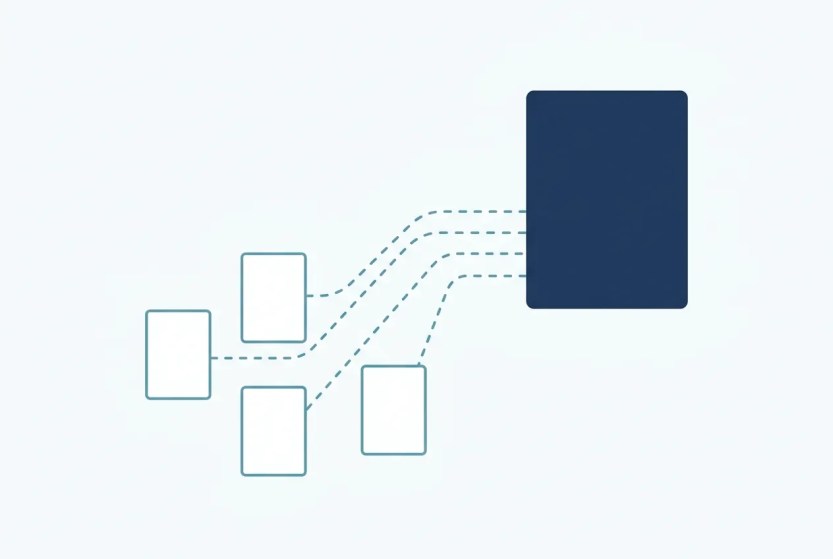
Generative Engine Optimization (GEO) is the practice of structuring content, entities, and technical signals so AI systems like ChatGPT, Google AI Overviews, Perplexity, and Gemini can find, understand, and cite your brand directly in generated answers. Where SEO earns rankings, GEO earns citations — visibility inside the answer itself, not just a link beside it.
Key Takeaways
- GEO (Generative Engine Optimization) earns brand citations inside AI-generated answers — SEO earns ranked positions in blue-link results. Both are necessary for full search visibility in 2026, but they require different strategies and different success metrics.
- Most generative AI systems use retrieval-augmented generation (RAG), which makes technical SEO a strong foundation for GEO — though not a strict prerequisite: Ahrefs found 28.3% of ChatGPT’s most-cited pages have no organic keyword visibility in Google at all.
- AI Overviews reduce position-1 organic click-through rate by 58%, and the overlap between top-10 rankings and AI Overview citations has fallen sharply — ranking well no longer guarantees AI visibility.
- The four core building blocks of GEO are entity clarity, structured data (JSON-LD schema), semantic content organization, and answer-first content design. Of these, entity clarity and answer-first design have the strongest published support; schema’s independent effect on citation is contested.
- GEO implementation follows a repeatable process — the Entity-to-Citation Framework: audit entities and schema gaps, restructure content for extraction, deploy technical fixes, and prove the framework before scaling.
- AI visibility is measured by Share of Model (SOM) and AI Share of Voice — not SERP position or CTR. These require dedicated LLM monitoring tools, and they must be read as trends, because AI Overviews change every 2.15 days on average.
- On a new domain with no backlinks, this framework preceded verified AI citations across Google AI Overviews, ChatGPT, and Perplexity within four months of launch — documented, with its limitations, in the linked case study.
- What Is Generative Engine Optimization, and Why Does It Matter in AI Search?
- Why Does GEO Matter More Now Than a Year Ago?
- How Does GEO Differ from SEO and AEO?
- What Are the Core Building Blocks of GEO?
- How Do You Implement GEO? The Entity-to-Citation Framework
- How Do You Measure and Monitor AI Search Visibility?
- Frequently Asked Questions
What Is Generative Engine Optimization, and Why Does It Matter in AI Search?
Generative engine optimization matters because AI Overviews, ChatGPT, and Perplexity now answer many queries without a single click to any website. If your content isn’t structured for machines to extract, verify, and cite, competitors who are structured correctly get named instead — even when your product, article, or expertise is objectively stronger.
If you’re asking “what is generative engine optimization” because you’ve noticed clicks dropping while impressions hold steady in Search Console, you’re not imagining it — the traffic is going to the answer, not to you.
Traditional SEO measures success by rankings and click-through rate. GEO measures a different outcome entirely: whether an AI system extracts your content, trusts it enough to summarize, and names your brand in the answer it hands back to the user. Ranking position can be irrelevant if the citation never happens.
Under the hood, most generative answer engines work the same way regardless of vendor. ChatGPT’s browsing mode, Google’s AI Overviews, and Perplexity all retrieve a set of candidate pages, extract passages that answer the query, and generate a synthesized response grounded in those passages — a process generally known as retrieval-augmented generation (RAG). GEO is the discipline of making sure your content is retrievable, extractable, and citation-worthy at every step of that pipeline, not just indexable.
That RAG dependency is why strong technical SEO remains a solid foundation for GEO — but it is a foundation, not a gate. Ahrefs found that 28.3% of ChatGPT’s most-cited pages have no organic keyword visibility in Google at all, which means AI citation and Google ranking are partly separate discovery layers. Fixing crawlability and indexation is still the right first move; assuming a page must rank before it can be cited is not.
This is a revenue question, not a theoretical one. In my own work, I established organic search as the #1 acquisition and revenue channel for a brand I managed, growing organic revenue 146% year over year — a first-party figure from my own reporting. That growth was built on classic technical and content SEO, but it only stays intact if the same content keeps earning visibility as search shifts from a list of blue links to a single generated answer. Treating GEO as optional means treating a channel you already depend on as expendable.
This page is written as a complete, practitioner-led generative engine optimization guide: a framework built from implementing these fixes directly on live sites and tracking what happened afterward, with published third-party research cited where it supports — or contradicts — what I observed.
Why Does GEO Matter More Now Than a Year Ago?
GEO matters more now because AI Overviews are actively suppressing organic click-through rates, and the pages AI systems cite are increasingly different from the pages ranking highest in traditional search. According to Ahrefs (February 2026), AI Overviews reduce position-1 organic click-through rate by 58% — up from 34.5% roughly ten months earlier, meaning the erosion is accelerating rather than stabilising.
On the ranking-to-citation overlap, the published figures genuinely disagree, and it is worth knowing the range rather than one number. Ahrefs’ March 2026 analysis of 863,000 keywords and roughly 4 million AI Overview URLs found 37.9% of cited pages also appeared in the top 10 for the same query, down from 76.1% in its July 2025 study — though Ahrefs notes its citation detection improved between the two, so the datasets are not directly comparable. BrightEdge’s analysis puts the overlap considerably lower, at roughly 17%. Both are large datasets from credible vendors; the gap reflects different measurement methodologies and query populations. The direction is not in dispute — top-10 ranking has become a much weaker predictor of AI citation. The precise magnitude is.
The mechanism behind this shift is Google’s query fan-out process: when an AI Overview triggers, Google doesn’t just answer the query you typed — it silently generates a cluster of related sub-queries and pulls candidate sources across that whole cluster before selecting what to cite. A page can rank #1 for the exact phrase a user searched and still lose the citation to a competitor that covers the surrounding topic cluster more completely. This is why the Entity-to-Citation Framework treats topical and entity coverage as the primary lever, not the primary keyword in isolation.
For a brand still measuring success purely by rank tracking, this is the practical consequence: rankings can hold steady while both clicks and citations quietly decline. The Search Console pattern is usually the first sign — impressions holding, clicks falling — which is the exact symptom this guide opened with.
How Does GEO Differ from SEO and AEO?
GEO, SEO, and AEO overlap but aren’t interchangeable. SEO optimizes for ranking in a list of links. AEO (answer engine optimization) optimizes for being the single extracted answer to a direct question — a passage pulled from one page. GEO optimizes for being cited, quoted, or recommended inside a generative AI response — ChatGPT, Gemini, Perplexity, and Google’s own AI Overviews — where a model synthesizes an answer from several sources rather than extracting one. AEO and GEO share a foundation of clean technical SEO and authoritative content, but they diverge in execution, target surface, and measurement, and work best run as one coordinated strategy rather than two separate ones.
The three disciplines share a foundation — clean technical architecture, authoritative content, accurate structured data — but diverge in what they’re optimizing for. SEO targets the SERP. AEO targets the featured snippet or voice-assistant answer box for a single, well-defined question. GEO targets the full generative response layer, where a model might synthesize, paraphrase, or directly quote your content alongside three or four competitors in a single answer.
In practice, this means GEO overlaps heavily with technical SEO — schema, crawlability, entity clarity — but adds a requirement AEO and classic SEO don’t: content has to survive being lifted out of context and recombined by a model. A page can rank #1 and never get cited. A page ranking #8 can be the only one quoted by name.
That’s also why Google’s own AI Overviews sit on the GEO side of this line even though Google owns the surface: an AI Overview is generated by combining and paraphrasing several sources into new text — the same synthesis mechanism ChatGPT and Perplexity use — not the single-source extraction a featured snippet performs. For the full operational breakdown of where AEO and GEO actually diverge — schema priority, platform scope, and how each is measured — see AEO vs GEO: Where They Actually Diverge.
Search behavior reflects the confusion. “Generative engine optimization vs SEO” shows up as an early-stage research query from marketers trying to figure out where to allocate budget — usually the answer isn’t “instead of,” it’s “in addition to, with a different success metric.” Search “geo vs seo vs aeo” and most explainers stop at definitions without addressing measurement, which is exactly what the measurement section of this guide covers.
This section is intentionally brief. For the full breakdown — workflow differences, deliverables, and how to explain the distinction to stakeholders used to ranking reports — see the full GEO vs SEO comparison.
What Are the Core Building Blocks of GEO?
The core building blocks of GEO are entity clarity, structured data (schema and JSON-LD), semantic content organization, and content design that isolates clean, quotable answers. Together they let AI systems identify what your brand is, verify it against a knowledge graph, and extract passages confidently enough to cite without needing to visit the page. Of the four, entity clarity and answer-first content design have the strongest published support; structured data’s independent contribution to citation is contested, and is covered below.
Entity SEO: Becoming a Recognized Entity, Not Just a Keyword
Entity SEO is the practice of making your brand, products, and key people identifiable as distinct, verifiable entities rather than strings of text that happen to match a query. AI systems weigh entities that resolve consistently across a knowledge graph — matching name, description, and relationships everywhere they appear — more heavily than unstructured brand mentions. That means consistent naming across your site, your Google Business Profile, your social profiles, and any third-party mentions you control, all reinforcing the same identity.
This is the building block I would prioritize above the others, and the evidence supports that ordering. Ahrefs’ brand-signal research found off-site brand mentions — YouTube mentions in particular — correlating more strongly with AI visibility than any conventional SEO metric tested, including backlinks and domain rating. Practitioner consensus points the same way: without a clearly resolved brand entity, AI systems have to guess who you are, and that ambiguity reduces citation confidence. I’ve documented a real case of this exact failure mode — a brand name colliding with an unrelated business — and what fixed it in entity disambiguation for AI search.
Structured Data, Schema, and JSON-LD
Structured data is how you tell a crawler or model explicitly what a page is, rather than hoping it infers correctly. Organization, Product, and Article schema, implemented as JSON-LD, disambiguate content type and entity relationships in a format machines parse directly instead of guessing at from prose. Use @graph and @id so your blocks reference one another rather than sitting in isolation — connected entities are more legible than disconnected ones — and keep the markup consistent with what is visible on the page, since schema describing content that isn’t there reduces trust rather than building it.
An honest caveat, because this is where most GEO advice overreaches. Google states that no special structured data is required for AI Overviews. SE Ranking’s analysis of 2.3 million pages found FAQPage schema had no measurable impact on AI Mode citations, while FAQ sections in the visible content did correlate with more citations. Ahrefs’ own research reached a similar conclusion, finding effectively no correlation between schema markup and AI citation. Both Google and Microsoft have confirmed that structured data helps their AI systems understand and verify content — but that is a claim about comprehension, not about citation. Implement accurate schema because it clarifies your entity and costs little once correct. Do not budget for it as the lever that earns citations.
I implement this schema directly in Shopify Liquid templates, WordPress, and raw JSON-LD — without routing every change through a developer queue, which matters when citation windows can open and close faster than a typical sprint cycle.
Semantic SEO and Topical Authority
Semantic SEO organizes content around concepts and relationships rather than isolated keywords, and topical authority is the accumulated trust a domain earns by covering a subject comprehensively instead of publishing one thin page per query variant. Models are more likely to cite a source that visibly covers a topic in depth — internally linked, consistently terminologized, without contradictory claims across pages — than a single isolated article, however well-optimized that one page is.
Note that depth of coverage is not the same as length. Ahrefs found a near-zero correlation between word count and AI Overview citation, with a majority of cited pages running under 1,000 words. Cover the question completely, then stop.
Knowledge Graph SEO and Content Design for Extraction
Knowledge graph SEO is the layer that connects your entities to the broader web of verified facts — sameAs links to Wikidata, Wikipedia, and authoritative profiles, consistent NAP data, and disambiguation from similarly named entities. Content design is the final piece: short, self-contained definitional paragraphs; headers phrased as the questions people actually ask; lists over dense paragraphs; and claims stated once, clearly, rather than restated three different ways for “engagement.”
This is the building block with the most direct research support. Growth Memo found pages whose headlines directly answer the question are cited by ChatGPT 41% of the time, against 29% for loosely related headlines, and that 44.2% of LLM citations come from the first 30% of a text. This is the same answer-first structure behind good search experience optimization — content designed around how a real reader (or a model standing in for one) actually extracts an answer, not around how much space it fills on a page.
How Do You Implement GEO? The Entity-to-Citation Framework
I call this the Entity-to-Citation Framework, because every step moves your brand from an unstructured mention toward a verifiable, citable entity. It starts with an entity and schema audit, moves through content restructuring for answer-first extraction, and ends with technical deployment — usually JSON-LD, Shopify Liquid, or WordPress template changes — followed by continuous citation monitoring. It’s a repeatable process, not a one-time project, because model behavior and AI Overview triggers change continuously.
Step 1: Audit Entities and Schema Gaps
Before writing anything new, map what AI systems can currently see. Pull every page’s existing schema — or lack of it — check whether your brand, products, and key people resolve as distinct entities, and identify which competitor content is already being cited for your target queries. Confirm the last-crawl date on revenue-critical URLs while you are in Search Console: a page Googlebot has not revisited cannot reflect any change you make to it, which makes crawl recency a prerequisite for everything downstream. I run this audit as a Make.com pipeline connecting Claude and the Google Search Console API, which flags entity and content gaps at scale instead of one page at a time.
Step 2: Restructure Content for Extraction — This Is LLM SEO
This is the core of LLM SEO: optimizing specifically for how large language models parse, weight, and reuse content, rather than how a ranking algorithm scores it. In practice, that means leading every section with a direct, self-contained answer; breaking claims into discrete, verifiable statements; using consistent terminology instead of creative variation; and cutting the throat-clearing paragraphs that ranking-focused SEO tolerates but extraction models skip past. If you’re trying to optimize for ChatGPT specifically, it currently favors clearly labeled comparisons and named entities over narrative writing — structure accordingly.
Step 3: Deploy Technical Fixes Without a Developer Queue
Founders and marketers researching how to optimize for AI search usually already have decent content — what’s missing is the technical layer that lets a model find and trust it fast enough. I implement GEO fixes directly in Shopify Liquid, WordPress templates, and JSON-LD schema without waiting on a developer sprint. AI Overview optimization in particular rewards speed: the gap between a content or schema change going live and a model’s next crawl or retrieval cycle determines whether you’re the one who shows up in AI search results, or the competitor who deployed first.
Step 4: Prove the Framework Works Before Scaling It
On a new domain with no backlinks, within four months of site launch — and on a blog post that had been live for just two months — this framework preceded three separate in-text citations in a single Google AI Overview response, a named product recommendation in ChatGPT, and both image and link citations in Perplexity. One precision worth stating here rather than burying: the domain was new, but the brand entity was anchored through Organization schema to an established parent company, so “zero authority” describes the domain, not the entity.
The Google AI Overview citations case study documents that implementation in full — the six tactical steps, the exact schema stack, and the entity architecture — alongside an explicit account of what a single case can and cannot establish. Several elements were deployed together, so the case demonstrates that the approach is viable rather than isolating which component produced the result. Read it as a documented proof point and a starting hypothesis, not as attribution.
GEO doesn’t replace the rest of a brand’s digital footprint — it’s one input into a wider online presence management strategy that also covers reputation, local presence, and cross-channel consistency, all of which affect whether a model trusts your brand enough to name it.
How Do You Measure and Monitor AI Search Visibility?
Measuring GEO performance means tracking whether AI systems cite you, not just whether you rank. Core metrics are AI Share of Voice (how often you’re mentioned versus competitors within AI answers), Share of Model, and direct citation tracking across ChatGPT, Perplexity, and Google AI Overviews — measured with dedicated LLM monitoring tools, not traditional rank trackers, and read as trends rather than point-in-time snapshots.
AI Share of Voice and Share of Model
AI Share of Voice measures how often your brand appears in AI-generated answers relative to competitors for a defined set of queries — the AI-era equivalent of SERP share of voice. Share of Model (SOM) is the broader version of that metric across a model’s full range of relevant outputs, not just a fixed keyword set. In one engagement, I achieved 100% brand visibility in ChatGPT responses and the #1 position in AI Share of Voice at 22.6%, tracked via Waikay against a competitive set that included BLACK+DECKER, Ryobi, and other national brands. Those are first-party figures from my own tracking, and the comparison set is the point: a small business holding the top share-of-voice position against national manufacturers is a different result from the same number in an uncontested category.
One measurement caution that changes how you read your own dashboard. AI citations are far more volatile than rankings. Ahrefs’ November 2025 study of 43,000 keywords found AI Overviews have a persistence of just 2.15 days on average, with only 54.5% of cited URLs overlapping between consecutive observations — and Ahrefs notes its checks were not daily, so the real rate is likely higher. Track SOM as a trend across a fixed prompt set over weeks. A citation that vanishes overnight is usually baseline variance, not a regression to diagnose.
The LLM Monitoring Stack
This is what AI visibility monitoring looks like in practice, and it requires a different toolset than classic rank tracking. My stack: Waikay for AI Share of Voice and citation tracking across models, Sitebulb and Screaming Frog for crawl-level schema and entity audits, and Google Search Console and GA4 for confirming that AI-driven visibility eventually shows up as branded search demand and referral traffic — not just citations in a dashboard. None of these tools work in isolation. Citation data without traffic data tells you a model likes you; it doesn’t tell you whether that’s moving revenue.
I’ve mapped the full AI visibility monitoring setup — tools, monitoring cadence, and what to do when citations drop — as part of the broader GEO vs SEO comparison.
Want this implemented for your brand?
I audit AI search visibility using Vantage (my proprietary GEO/SEO intelligence dashboard) and a multi-agent Claude Code SEO system — identifying exactly why your brand isn’t appearing in AI search results and what to fix first.
Frequently Asked Questions
What is generative engine optimization?
Generative engine optimization (GEO) is the practice of structuring content, entities, and technical signals so AI systems like ChatGPT, Google AI Overviews, Perplexity, and Gemini can find, understand, and cite a brand directly inside a generated answer, rather than only ranking a link beside it.
How is GEO different from SEO?
SEO optimizes for ranking position in a list of links; GEO optimizes for being extracted, quoted, or named inside an AI-generated response. The two share the same technical foundation — schema, crawlability, content quality — but GEO adds a requirement SEO doesn’t: content has to survive being lifted out of its original page and recombined by a model. The two are also less tightly coupled than they once were: Ahrefs found 28.3% of ChatGPT’s most-cited pages have no organic keyword visibility in Google at all.
What is LLM SEO?
LLM SEO is the subset of GEO focused specifically on how large language models process content during retrieval and generation: consistent terminology, self-contained factual statements, and answer-first structure that survives being paraphrased or quoted out of context. It’s less about narrative flow and more about making individual sentences independently extractable and verifiable.
Does schema markup help with GEO?
Less than most GEO advice implies. Google states no special structured data is required for AI Overviews, and two large independent studies — SE Ranking’s analysis of 2.3 million pages and Ahrefs’ own AI search research — found no measurable effect from schema markup on AI citation rates. Both Google and Microsoft have confirmed structured data helps their AI systems understand and verify content, which is a claim about comprehension rather than citation. The reasonable position: implement accurate Organization, Product, and Article schema because it clarifies your entity and costs little once correct, keep it consistent with what is visible on the page, and put your effort into entity clarity and answer-first content structure instead — those are the levers with published support.
How do you measure GEO performance?
Track AI Share of Voice (how often your brand appears in AI answers versus competitors), direct citation counts across ChatGPT, Perplexity, and Google AI Overviews, and downstream branded search and referral traffic in GA4 and Search Console. Rank tracking alone won’t show this — you need dedicated LLM monitoring tools built to query AI systems directly and log what they say. Read the results as trends over weeks: Ahrefs found AI Overviews change every 2.15 days on average, so a single day’s reading is noise.
What is Share of Model (SOM)?
Share of Model measures how often a brand is surfaced across the full range of a given AI model’s relevant outputs, not just a fixed list of tracked keywords. It’s a broader lens than AI Share of Voice, which typically measures visibility against a defined query set — SOM asks how consistently a model reaches for your brand whenever the topic is relevant at all.
How long does GEO take to work?
There’s no universal timeline — it depends on domain authority, content freshness, entity clarity, and how aggressively competitors are already optimizing. In one case I documented directly, a new domain with no backlinks earned multiple AI Overview and Perplexity citations within four months of launch, on a blog post that had been live for only two months, with the brand entity anchored to an established parent company through schema. That is evidence GEO can move fast under favourable conditions, not a timeline to expect by default.
