

Last updated: July 2026
The SEO Avalanche Theory is an organic search strategy for small businesses and e-commerce brands that matches keyword difficulty to a site’s current traffic tier — targeting keywords whose search volume sits at or just above your existing daily organic traffic, then stepping up to progressively larger tiers as each round of rankings lifts your baseline. Rather than competing immediately for high-volume terms, the method compounds early low-competition wins into growing authority until the site can win harder terms, without requiring a large backlink budget to start.
This guide explains how the SEO Avalanche Theory works, how it differs from traditional SEO strategies, and how to implement it step by step — including identifying Keyword Golden Ratio (KGR) opportunities, building content clusters, and using the allintitle: search operator to find low-competition gaps your competitors have overlooked.
Key Takeaways
- The SEO Avalanche Theory enables small businesses to grow rankings rapidly by compounding quick, low-competition wins into a self-reinforcing momentum cycle.
- The method works in traffic tiers: you match keyword difficulty to your site’s current daily organic traffic, then step up a tier as each round of rankings lifts your baseline.
- The avalanche approach prioritizes agility and targeting strategic “keyword golden gaps” — low-competition, high-intent queries overlooked by larger competitors with bigger budgets.
- The Keyword Golden Ratio (KGR) and the allintitle: Google search operator are the two most accessible tools for identifying genuine low-competition keyword opportunities without paid tools.
- A step-by-step SEO checklist aligned with business goals — covering site structure, content, internal linking, and keyword targeting — ensures each action compounds rather than operates in isolation.
- Continuous performance monitoring and agile content updates are what separate a successful SEO avalanche from a one-time optimization that stalls after initial gains.
- In 2026, the avalanche approach extends beyond Google rankings — low-competition, long-tail content also increases the probability of being cited in AI-generated answers from ChatGPT, Gemini, and Perplexity.
This post contains affiliate links. If you make a purchase through them, I may earn a small commission at no extra cost to you. Thanks for your support!
- What Is the SEO Avalanche Theory and How Does It Work?
- How Does the Avalanche Technique Differ From Traditional SEO Strategies?
- How Do You Maximize Ranking Potential for Your E-Commerce Site?
- How Do You Find Keyword Golden Opportunities for Faster SEO Results?
- How Do You Implement an SEO Avalanche for Explosive Growth?
- How Does the SEO Avalanche Approach Apply to AI Search in 2026?
- Frequently Asked Questions
- Conclusion
What Is the SEO Avalanche Theory and How Does It Work?
The SEO Avalanche Theory works by targeting low-competition keywords first — accumulating early ranking wins that build domain authority and search engine trust, which then makes it progressively easier to rank for more competitive terms. Like a snowball gaining mass as it rolls downhill, each compounding win accelerates the next, allowing small e-commerce brands to outmaneuver larger competitors despite having smaller budgets and newer domains.
Unlike traditional “set-and-forget” SEO methods, the avalanche model thrives on momentum and adaptability, giving you tangible results faster and with less risk. It’s about building search engine momentum through strategic planning and execution.
The SEO Avalanche Theory offers distinct advantages for small businesses and e-commerce brands:
- Faster Momentum: It leverages early victories — like initial ranking surges for lower-competition keywords — to build authority and trust with search engines. Each small win creates a stepping stone for targeting more competitive keywords later.
- Cost-Effective Growth: This cumulative effect improves rankings, increases traffic, and allows reinvestment in further growth with minimal upfront cost.
- Algorithm Alignment: It aligns with modern search engine algorithms that prioritize relevance, user experience, and authority — not just keyword density.
- Keyword Golden Gaps: By targeting long-tail and medium-tail keywords, you unearth opportunities often overlooked by larger brands competing on broad head terms.
- Agility and Adaptability: Constant performance monitoring, analytics-driven adjustments, and realignment to emerging opportunities keep the avalanche building rather than stalling.
- Content Lifecycle Optimization: Every new product page, blog post, or landing page becomes a potential accelerator. Consistent content updates stack authority over time rather than starting from scratch.
- Quality Over Quantity: The approach focuses on relevance, engaging user experience, and value-driven information — leading to lower bounce rates and higher conversion potential.
“Commit to a niche; try to stop being everything to everyone.”
— Andrew Davis, via Aragil
What Is a Traffic Tier, and How Do You Find Yours?
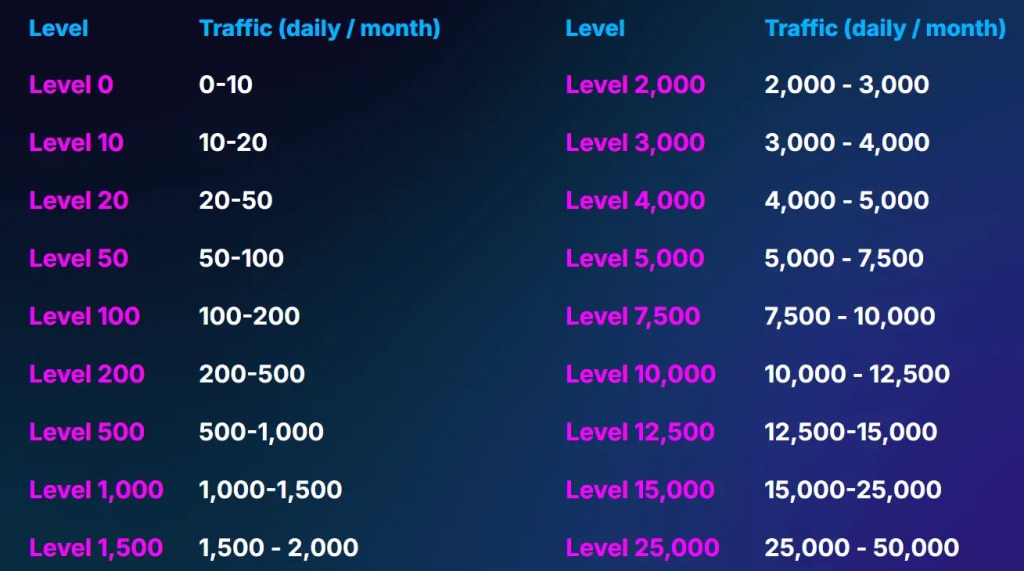
A traffic tier is the band of keyword difficulty a site can realistically win given its current organic click volume. In the avalanche model you identify your tier by averaging daily organic clicks across the previous three months, then target keywords whose monthly search volume sits at or just above that baseline — moving up a tier only once the current round of content is holding its rankings.
To find yours: open Google Search Console, set the date range to the last three months, and divide total clicks by the number of days. That daily average is your working tier — as an example, a site averaging 20 clicks a day would look to the chart below to find which volume band that falls into, rather than reaching for a 2,000-volume head term regardless of relevance. The chart below maps the tier bands most commonly used in avalanche planning; use its published ranges rather than a rule of thumb.
One clarification most avalanche write-ups skip: traffic tiers are a practitioner heuristic, not a documented Google mechanism. Google has never confirmed that it sorts sites into traffic bands or gates rankings by them. What the tier model actually does is give you a disciplined way to estimate what your domain can currently win, so you stop spending content budget on terms that were never reachable. The framework earns its place because the underlying constraint is real — not because there’s a tier field in Google’s index.
How Does the Avalanche Technique Differ From Traditional SEO Strategies?
Traditional SEO strategies focus on broad, high-competition keywords with slow, predictable content schedules and reactive responses to algorithm changes — often requiring significant upfront investment before yielding visible results. The SEO Avalanche Technique, by contrast, prioritizes immediate traction through low-competition keywords, continuous content momentum, and proactive adaptation — compounding smaller wins into an accelerating growth curve.
Traditional SEO Strategies Often Feature
- Heavy focus on broad or highly-competitive keywords.
- A predictable, static cadence of content publishing.
- Sporadic, “set-and-forget” optimization efforts.
- A reactive stance towards algorithm updates and market shifts.
- Higher upfront risk due to large-scale, slow-to-return investments.
The Avalanche Technique, in Contrast, Harnesses
- Targeted wins via long-tail and niche keywords with lower competition.
- A dynamic mindset focused on continuous momentum and compounding efficiency.
- Rapid positive signals to search engines by stacking smaller victories.
- A proactive approach anticipating changes in search behavior and competitor gaps.
- Reduced risk, with initial successes fueling reinvestment and compounding authority.
The avalanche technique also places content quality at its heart — moving beyond simply churning out pages. It’s about engineering valuable, user-intent-driven content that genuinely answers search queries. This means regularly refreshing existing resources, strategically layering in optimized product pages, and treating every asset as part of a living, evolving strategy. For a deeper look at how content architecture and topic clusters support this approach, see the pillar pages and topic cluster guide.
How Do You Maximize Ranking Potential for Your E-Commerce Site?
Maximizing your e-commerce site’s ranking potential means moving past generic SEO advice and embracing tactics proven to increase site visibility quickly — especially against established competition. With the SEO Avalanche Theory, you identify viable ranking opportunities even within saturated markets by targeting low-competition keywords and compounding quick wins into a growing base of topical authority.
Identifying Low-Competition Opportunities and Quick Wins
Many e-commerce business owners underestimate their site’s true ranking potential by exclusively chasing high-competition keywords. Consistently building momentum through lower-competition opportunities is often the fastest path to dominating your niche. Here’s why prioritizing these low-competition “quick wins” is fundamental to the Avalanche method:
- Faster Traction: You gain initial ranking traction more quickly, generating traffic and conversion data that informs the next phase of targeting.
- Compounding Momentum: Each early win builds authority and trust with search engines, allowing you to establish a stronger base for targeting more competitive terms later.
- Reduced Competition: You face significantly less direct competition compared to broad, high-volume terms targeted by larger brands.
- Direct Authority Building: Successfully targeting these areas bolsters site visibility and steadily builds domain authority — serving as a stepping stone for future growth.
Here’s how to start harnessing the exponential power of the SEO Avalanche by prioritizing low-competition SEO plays:
- Use Keyword Tools: Begin with tools that focus on difficulty metrics. Filter keyword lists to phrases that blend a healthy balance of search volume and low competition — look for those regularly ignored by bigger retailers.
- Explore Niche & Long-Tail: These opportunities are often hidden in niche-specific long-tail keywords, product-specific questions, or hyper-local search terms. For instance, while “blue running shoes” may be crowded, “best blue running shoes for flat feet women” or “durable blue running shoes under $100” typically have fewer competing pages — and attract buyers with higher purchase intent.
- Analyze Your Own Data: Look into your site’s Google Search Console for queries generating impressions but not clicks, or those floating just outside the top 10 or 20 results. These are low-hanging fruit for quick wins.
- Implement Content Clusters: Organize your site’s content into tightly knit topical clusters around low-competition topics. This signals depth and relevance and enables more effective internal linking.
- Stay Agile: Keep a regular check on competition and industry trends to identify fresh pockets of low-competition opportunity as they emerge.
- Prioritize Speed-to-Publish: Low-competition keywords can become saturated quickly. Acting swiftly to create content for identified opportunities is crucial.
- Focus on Conversion Intent: Prioritize low-competition keywords that align with high buying intent, converting visibility directly into revenue rather than just traffic.
Long-tail keywords are less competitive and usually composed of more than three words, making them more qualified because they offer clearer search intent — and therefore higher conversion potential than broad head terms.
— Serpstat, A Beginner’s Guide to Leveraging Long Tail Keywords, 2023
How Do You Find Keyword Golden Opportunities for Faster SEO Results?
Keyword Golden Opportunities — sometimes called Keyword Golden Ratio (KGR) terms — are search queries with enough monthly search volume to generate meaningful traffic, low enough competition for a newer or smaller domain to rank, and high enough buyer intent to convert. Finding them requires a combination of keyword research tools, the allintitle: Google search operator, and analysis of your own GSC impression data for queries already gaining traction.
Tools and Methods to Discover Profitable Keyword Golden Gaps
The Keyword Golden Ratio was introduced in 2017 by Doug Cunnington of Niche Site Project as a data-driven method for finding long-tail keywords with low competition — dividing the number of allintitle: results by monthly search volume, and targeting terms scoring 0.25 or below with fewer than 250 monthly searches. It pairs naturally with the avalanche’s tier model: Carter’s framework tells you which tier to target, KGR tells you which keywords inside that tier are actually winnable. Understanding what makes a keyword “golden” is the first step. These are usually search queries that possess a sweet spot of: decently high intent, enough monthly searches to warrant targeting, and low competition. A truly golden gap is one where larger competitors haven’t invested — meaning you can claim rankings with well-optimized content and start building traffic authority before the gap closes.
The allintitle: Google search operator is one of the most accessible tools for identifying these gaps without a paid SEO platform. When you type allintitle: followed immediately by your keyword phrase into Google (for example, allintitle:best waterproof hiking boots), Google shows only pages that have all those specific words in their title tag — revealing exactly how many pages are intentionally optimized for that precise phrase.

When the number of allintitle: results is far lower than the keyword’s monthly search volume, it signals genuine low direct competition — a strong indicator of a keyword golden gap. However, allintitle: is one valuable indicator within a broader strategy; Google’s algorithms consider many other factors including content quality, user experience, and backlinks.
To uncover these gems, the right toolkit and complementary methods are essential:
- Mainstream SEO Platforms: Use tools like Ahrefs, SEMrush, or Moz to analyze overall keyword difficulty, search volume, and competitive density for a broader view before applying the allintitle: filter.
- Traffic Tier Prioritization: Match your keyword shortlist to your site’s current tier before committing to content — see What Is a Traffic Tier, and How Do You Find Yours? above for how to calculate yours. Layering multiple keywords within a single tier compounds results faster than scattering effort across several.
- Leverage Google’s Own Features: Use Google’s autocomplete, People Also Ask boxes, and related searches to surface new trends and keyword phrases dynamically shaped by real user demand.
- GSC Impression Mining: In Google Search Console, filter by “Impressions > 100” and “Position > 10” to find keywords where your site is gaining visibility but not yet clicks — these are your fastest avalanche accelerators.
How Do You Implement an SEO Avalanche for Explosive Growth?
Implementing the SEO Avalanche requires executing a structured, sequenced checklist that builds from technical foundations through content strategy to authority development — each phase compounding the gains of the previous one. The goal is not to complete each step once, but to cycle through them continuously, adding force to your avalanche with each iteration.
Step-by-Step SEO Checklist for E-Commerce Success
- Find Your Traffic Tier: Average your daily organic clicks in GSC across the last 90 days. That figure sets the keyword volume band you can realistically target this cycle, and the ceiling you’ll raise on the next one. Establish it before keyword research, not after.
- Technical Foundation: Audit crawlability, indexation, Core Web Vitals, mobile usability, and site speed. Fix technical issues before building content — a leaky foundation dilutes every subsequent effort.
- Keyword Research: Identify 10–20 low-competition, high-intent keywords using the KGR method and allintitle: operator. Prioritize those generating GSC impressions but not clicks.
- Content Architecture: Build topic clusters around your pillar keywords. Each cluster page targets a specific long-tail variant and links back to the pillar page — distributing authority across the cluster.
- On-Page Optimization: Optimize titles (primary keyword in first 60 characters), meta descriptions (benefit-led, under 115 characters), H2 headings phrased as questions, and answer-first paragraph structure for AI extraction readiness.
- Internal Linking: Connect new content to existing high-authority pages on your site using descriptive, keyword-rich anchor text. Never use generic “click here” or “learn more” anchors.
- Schema Markup: Implement Article, FAQPage, Product, and Speakable schema to improve structured data signals for both traditional search and AI engines.
- Content Quality Pass: Verify every factual claim traces to a named primary source. Replace unverifiable secondary citations with practitioner observations or confirmed data.
- GSC Monitoring: Submit updated content for fresh indexing. Monitor position changes, CTR, and impression growth weekly for the first 30 days after publication.
- Iteration Cycle: Every 90 days, repeat the keyword research and content audit steps. Update existing posts with new data, improved structure, and freshly identified low-competition opportunities.
This systematic approach is at the heart of how search experience and organic growth compound together — aligning SEO execution with user intent at every stage. For a deeper understanding of how on-page experience signals interact with SEO and conversion performance, see the Search Experience Optimization (SXO) guide.
How Does the SEO Avalanche Approach Apply to AI Search in 2026?
In 2026, the SEO Avalanche approach extends naturally into AI search visibility. The same low-competition, long-tail content that ranks quickly in Google also tends to be cited in AI-generated answers from ChatGPT, Gemini, and Perplexity — because AI engines prefer specific, authoritative, answer-first content over broad, keyword-stuffed pages. Building your avalanche with answer-first structure and FAQ schema makes each piece of content a dual-purpose asset: ranking in traditional search and appearing in AI-generated answers simultaneously.
The connection between the avalanche’s content specificity and AI citation readiness is not coincidental. AI engines evaluate content using the same signals that make low-competition content effective: structural clarity, entity completeness, and factual specificity. A long-tail piece targeting “best waterproof running shoes for flat feet women” that leads with a direct answer, includes FAQ schema, and cites specific product attributes is exactly the type of content both Google and ChatGPT prefer to surface for hyper-specific queries.
For a complete breakdown of how to structure content for AI citation readiness alongside traditional SEO performance, the GEO vs SEO guide covers the technical and content requirements in depth. And for brands managing visibility across search, social, local, and AI channels simultaneously, see the online presence management framework that connects all five visibility pillars into one cohesive strategy.
A Note From Practice
When I applied the SEO Avalanche approach for a B2C e-commerce brand starting from near-zero organic visibility, the first 90 days focused entirely on long-tail, low-competition product and category keywords. The compounding effect moved the brand’s organic search from the #2 revenue channel to #1 within the year, with a 146% increase in organic search revenue year over year. The avalanche doesn’t feel dramatic at first. Then suddenly it does.
Frequently Asked Questions
What is a traffic tier in the SEO Avalanche method?
A traffic tier is the range of keyword difficulty a site can realistically rank for based on its current daily organic clicks. In the avalanche method you calculate yours by averaging daily organic clicks across the previous three months, then target keywords with monthly search volumes at or slightly above that figure, stepping up to the next tier once those rankings hold. Traffic tiers are a practitioner framework for estimating reachable competition, not a confirmed Google ranking mechanism.
What is the SEO Avalanche Theory?
The SEO Avalanche Theory is an organic search strategy for low-resource websites that targets low-competition, low-traffic keywords first — building ranking momentum and domain authority incrementally until the site can compete for higher-volume terms. The approach works like a snowball effect: small early wins compound into larger ranking gains over time without requiring a large backlink budget or high domain authority to start.
What is the SEO Avalanche Technique?
The SEO Avalanche Technique is the tactical implementation of the avalanche theory — systematically identifying and targeting keywords with search volumes under 50–100 per month and keyword difficulty scores below 20, publishing optimized content for each, and using the accumulated authority from those rankings to move progressively toward more competitive terms. It is specifically designed for sites with limited domain authority, small content teams, and no backlink acquisition budget.
Who created the SEO Avalanche Theory?
The SEO Avalanche Theory — also referred to as the SEO Avalanche Technique — was introduced by SEO practitioner Chris Carter, who coined the term and developed the traffic-tier framework for bootstrapped websites building traffic without initial domain authority or backlink-heavy strategies. The methodology — targeting keyword tiers matched to a site’s current traffic level — has since been adopted and documented by SEO practitioners including Kyle Roof of High Voltage SEO and PageOptimizer Pro, as a lower-cost alternative to link-building campaigns.
Does the SEO Avalanche strategy work without backlinks?
Yes — the SEO Avalanche strategy is specifically designed to build ranking authority without an active link acquisition campaign. By targeting keywords where low-DA pages already rank on page one, the approach demonstrates that topical relevance, content depth, and internal linking can drive rankings for a defined keyword tier without requiring external backlinks. As domain authority accumulates from these early wins, the site becomes more competitive for terms that do require link equity.
How does the SEO Avalanche approach apply to AI search in 2026?
The SEO Avalanche approach maps directly to AI search visibility strategy. Just as the avalanche targets low-competition SERP positions to build early ranking momentum, a GEO/AEO implementation targets low-competition, high-specificity queries where AI Overviews are present but poorly answered — earning early citations that build entity authority over time. Answer-first content structure, FAQPage schema, and entity consistency accelerate citation eligibility the same way low-KD keyword targeting accelerates traditional ranking momentum.
What is the difference between SEO Avalanche and traditional link building?
Traditional link building prioritizes acquiring external backlinks to increase domain authority before targeting competitive keywords. The SEO Avalanche approach inverts this sequence — targeting rankable keywords first to generate organic traffic and topical authority signals, then using that accumulated credibility to compete for harder terms. The avalanche strategy is lower-cost and accessible to bootstrapped sites; link building scales faster for sites with budget for outreach or digital PR campaigns. For most small e-commerce brands and content sites, the avalanche approach produces faster early results with lower resource investment.
Conclusion
The SEO Avalanche Theory is not a shortcut — it’s a smarter sequencing of effort. By starting where your domain can realistically win, compounding those wins into growing authority, and continuously iterating rather than treating SEO as a one-time project, small e-commerce businesses can outpace larger competitors who are slower to adapt and less nimble in their content strategy.
In 2026, that momentum extends beyond traditional search rankings. The same structural clarity, content specificity, and answer-first architecture that powers the avalanche approach also makes your content citation-ready for AI engines — building a compounding organic presence across every surface where your audience searches for answers.
Want help building your SEO avalanche?
I work with e-commerce and small business brands to identify keyword golden opportunities, build topic cluster architectures, and implement the technical and content foundations that make the avalanche compounding effect work — combining GSC data analysis, entity-based content strategy, and AI search visibility into one integrated growth plan.
Get in Touch →